
Architecture
A modular, layered architecture built on a five-stage sync pipeline: Import, Join, Attribute Flow, Projection, and Export. Every component is designed for reliability, auditability, and extensibility.
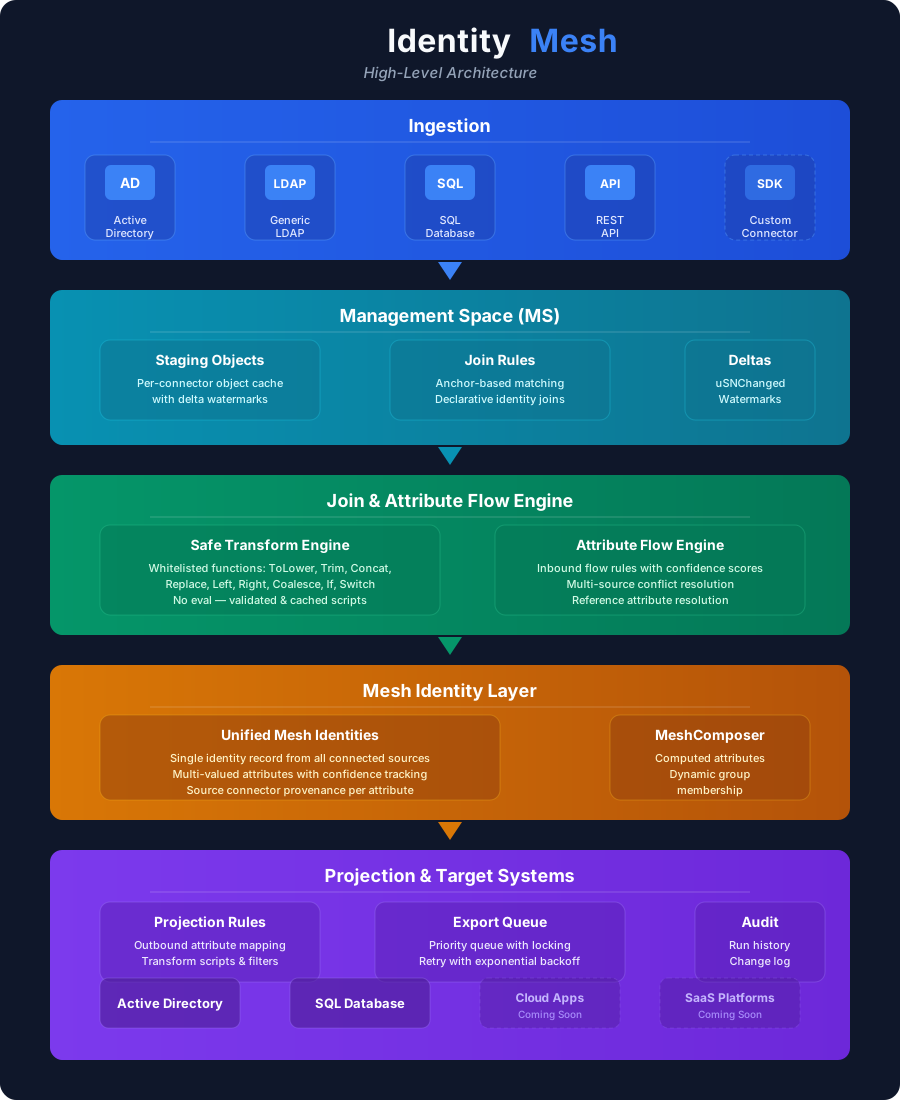
Sync Pipeline
Every identity change flows through five deterministic stages, each with its own rules and audit trail.
Import
Connectors read objects from source systems (Active Directory via LDAP, SQL databases via queries) and stage them into the Management Space. Supports full and delta import modes with watermark-based change detection.
Join
Join rules correlate imported connector objects to existing mesh identities. Each rule maps a connector-side attribute (SourceAttribute) to a mesh-side attribute (TargetAttribute). The engine reads the value directly from the raw connector object and searches existing mesh object attributes for a match — no inbound flow rules are required for the join to work. Multiple join rules are evaluated in order until a match is found. If no match exists and the anchor rule permits creation, a new mesh object is projected.
Attribute Flow
Inbound flow rules map connector attributes to mesh attributes. Each rule can include a transform script (ToLower, Trim, Replace, Concat, etc.) and a confidence score. When multiple sources provide the same attribute, the highest-confidence value wins.
Projection
Projection rules define how mesh objects are represented in each target system. Attribute rules map mesh attributes to target attributes, optionally applying outbound transforms. Delta computation compares projected values against the last exported snapshot to emit only actual changes.
Export
The export queue processes pending changes in priority order. Each item is locked, exported to the target connector, and marked complete. Failed exports retry with exponential backoff (up to 3 attempts). Pause/resume releases queued items back to pending.
Architecture Components
Sync Engine
Windows service that runs the five-stage pipeline on configurable schedules.
- Import, Join, Flow, Projection, Export pipeline
- Multi-instance with connector assignment
- Pause/resume with mid-sync cancellation
- Heartbeat monitoring and orphan run detection
- MeshComposer for dynamic group membership
Admin API & UI
REST API (.NET Minimal API) and Angular web console for configuration and monitoring.
- 60+ REST endpoints for full control
- Role-based access control (21 permissions)
- Audit log with per-object change tracking
- Export preview and queue management
- Dashboard with run history and change trends
Connector Layer
Pluggable DLL architecture for importing from and exporting to external identity systems.
- Active Directory (LDAP/LDAPS, delta via uSNChanged)
- SQL Database (SQL Server, Azure SQL, multiple auth modes)
- IIdentityConnector interface for custom connectors
- Hot-reload connector DLLs via FileSystemWatcher
- DPAPI-encrypted secrets with reference resolution
Key Capabilities
Built-in features that make Identity Mesh production-ready
Multi-Instance Engines
Run multiple sync engine instances across servers with connector-to-instance assignment. Each instance heartbeats independently and can be paused or resumed individually.
Confidence-Based Attributes
When multiple sources provide the same attribute, the value with the highest confidence score wins. HR systems can be authoritative for job title while AD is authoritative for login name.
Safe Transform Engine
No-eval expression engine with whitelisted functions (ToLower, Trim, Replace, Concat, Coalesce, etc.). Scripts are validated before storage and cached for performance.
MeshComposer
Dynamic group membership engine with nested criteria groups (AND/OR logic). Auto-populates groups based on attribute rules and publishes membership changes to target connectors.
Export Preview & Delta
Preview what would be exported per connector before committing. Snapshot-based delta computation ensures only actual changes are written to target systems.
Full Audit Trail
Every import, join, attribute change, and export is logged. Run history tracks adds, updates, and deletes per connector. Object-level audit shows the complete change history.
Deployment Model
Self-hosted on your infrastructure for complete data sovereignty
Sync Engine
Windows Service installed via MSI. Supports multiple instances on the same or different servers.
- Named instances via
--instance-name - DPAPI-encrypted credential storage
- Connectors loaded from local DLL folder
Admin API & Web UI
Minimal API with Angular frontend. Integrated Windows Authentication with role-based permissions.
- Negotiate (Kerberos/NTLM) authentication
- Swagger UI for API exploration
- SQL Server database (EF Core)
Technical Specifications
Technology Stack
Security
Integration Protocols
Data Model
Ready to See It in Action?
Let us walk you through the architecture and show how Identity Mesh fits your environment.